Rebuild
Why Does AI Get My Business Wrong When People Ask About It?
ChatGPT describes your business incorrectly because your knowledge lives in people's heads and PDFs and you never wrote it down. How to make your business readable by machines.
The Site Rescue starts the moment your order is placed. I’ll email you within one business day, usually much sooner, to get access and book the 30-minute intake call. If the site is under attack right now, call (754) 302-4631 after you pay.
AI describes your business incorrectly because it can only work with what you've published, and most businesses have never written down what they actually do in a form a machine can read. Your real knowledge lives in people's heads, in PDFs, in inboxes, and in a homepage that says "innovative solutions." AI-readability means giving machines one clear, structured, current, corroborated source of truth. sosSTEVIE builds that source of truth — the foundation your AI search visibility, your chatbot and your automation all sit on.
Key takeaways
- AI doesn't lie about you. It reports the most corroborated version of you that exists in public — usually four years old.
- Undocumented knowledge is invisible knowledge. If it's only in your head, it isn't real to a machine.
- Contradictions are worse than gaps. Three different addresses makes you an unreliable entity.
- This is the prerequisite. Chatbots hallucinate and AI search ignores you for the same root cause.
- Depth beats keywords. What gets cited is genuinely useful material, not optimized thin pages.
~/rebuild/ai-readable-business · source of truth
Rebuild · Quoted after the Site Rescue
Why Does AI Get My Business Wrong When People Ask About It?
ChatGPT describes your business incorrectly because your knowledge lives in people’s heads and PDFs and you never wrote it down. How to make your business readable by machines.
trace --where-did-each-detail-come-from
locationleft in 2021 ← 2 directory listings + a 2020 PDF price list on her own server
specialismwrong ← an old guest article about work she no longer did
second officeinvented? ← a registered address, never an office
the truth90 seconds on the phone. published: nowhere
# every wrong detail had a source
answer
AI describes your business incorrectly because it can only work with what you’ve published, and most businesses have never written down what they actually do in a form a machine can read. Your real knowledge lives in people’s heads, in PDFs, in inboxes, and in a homepage that says “innovative solutions.” AI-readability means giving machines one clear, structured, current, corroborated source of truth. sosSTEVIE builds that source of truth — the foundation your AI search visibility, your chatbot and your automation all sit on.
key takeaways
- AI doesn’t lie about you. It reports the most corroborated version of you that exists in public — usually four years old.
- Undocumented knowledge is invisible knowledge. If it’s only in your head, it isn’t real to a machine.
- Contradictions are worse than gaps. Three different addresses makes you an unreliable entity.
- This is the prerequisite. Chatbots hallucinate and AI search ignores you for the same root cause.
- Depth beats keywords. What gets cited is genuinely useful material, not optimized thin pages.
the story
Her first instinct was that she’d been defamed by a robot.
A client rang me genuinely upset. Someone had asked ChatGPT about her firm and it had confidently described a company that didn’t exist. Wrong services. Wrong specialism. A location she’d left in 2021. It had invented a second office.
So we went looking. Every single wrong detail had a source. The old location was still on two directory listings and the footer of a PDF price list from 2020 that was still sitting on her own server. The wrong specialism came from a guest article she’d written years ago about work she no longer did. The second office was a registered address that had never been an office at all.
The model hadn’t made anything up. It had done exactly what it was designed to do: gather what exists, weigh it, and produce the most corroborated story. The most corroborated story about her business was four years out of date, because she’d never published a better one.
She’d told me all the correct information in ninety seconds on the phone. Every bit of it was true, current, and completely undiscoverable. It lived in her head.
To a machine, that means it doesn’t exist.
where your knowledge actually is
Run this exercise. Four minutes. It’s uncomfortable.
You know all five answers instantly. Now tick only the ones that are written down, publicly, in a form a machine can read.
For nearly everyone, the honest answer is nowhere.
where it lives instead
Five places knowledge goes to be invisible.
Your head.
Perfectly clear, entirely inaccessible.
A PDF.
A capability deck from 2022 that four people have. PDFs are where knowledge goes to die: badly parsed, rarely indexed, never updated, and still the default way businesses write things down.
Your inbox.
You’ve explained your process beautifully, in prose, four hundred times. Every one of those explanations is locked in a private thread.
Your homepage, in code.
“Innovative solutions for the modern business.” Published ten million times, describing nothing. A machine reads it fine and correctly concludes it contains no information.
Directories from 2019.
Old address, old phone, old services, still authoritative, still being counted. Your knowledge isn’t just missing. It’s been replaced by a stale version that never got taken down.
why contradiction is worse than silence
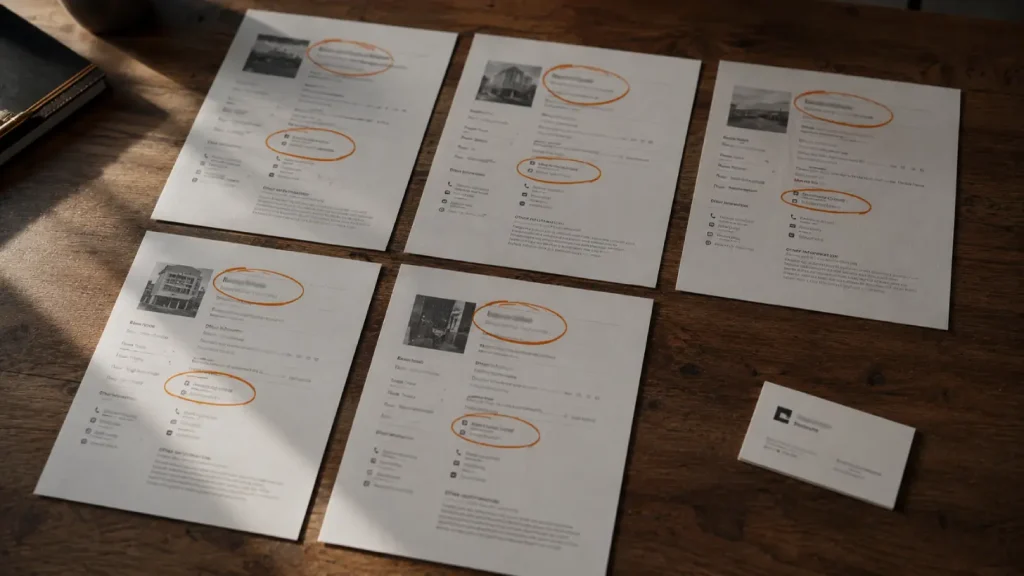
Answer engines resolve entities by corroboration.
They read many sources and ask: what does everyone agree on?
| Silent | Contradictory | |
|---|---|---|
| what you are | Absent. That’s bad. | Unreliable. Genuinely worse. |
| what the machine does | Finds nothing to say about you | Picks a winner between your site, a 2019 directory and an old profile |
| who wins | Nobody | Not the newest. The most corroborated. Your one accurate homepage loses to five stale listings that all agree with each other |
This is why “we updated our website” doesn’t fix it. You updated one source. You didn’t touch the eleven that outvote it.
The gap between what you know about your business and what a machine can find out about it is now a revenue gap. It just doesn’t appear in any report, because there’s no analytics line for “was described inaccurately in a conversation you’ll never see.”
depth beats optimization
The lesson came from an unlikely place.
Years ago I built a site about the history of rock and roll. Not for a client. Just something I cared about, and I went properly deep: the labels, the session players, the regional scenes, the arguments about who did what first. No keyword research. No optimization strategy. I wasn’t trying to rank; I was trying to get it right.
It out-performed nearly every client site I was being paid to optimize at the time. For years. And it wasn’t close.
I spent a long time slightly annoyed about that. The lesson I eventually took: search engines were always trying to find the most genuinely useful page, and I’d been spending my professional life trying to trick them into picking a thinner one. The hobby site won because it deserved to.
You can’t optimize your way into being the best source. You have to actually be it.
That was true then. It’s structurally true now. Answer engines are explicitly built to find the most authoritative, complete, corroborated source and quote it. There’s no thin-page strategy that survives that. Being the best source means writing down what you know in more depth than anyone else has bothered to.
Which is inconvenient, because it’s real work. It’s also the most durable competitive position available, precisely because most people won’t do it.
what anyone can control
So this service makes no ranking guarantees.
You should distrust anyone who does. What it does is make you the most complete, most consistent, most readable source of truth about what you do. Whether the systems pick you in any given week isn’t something I control, and anyone claiming otherwise is describing a lever that doesn’t exist.
in our control
What exists about you, and whether it agrees.
- The knowledge. Extracted from your head, written down.
- The structure. Real HTML, headings, schema, question-and-answer pairs. Never a PDF.
- Publication. Public and crawlable, on your own site.
- The stale sources. Every one I can reach, fixed or killed.
in nobody’s control
What a model decides to say.
- Which sources it weighs. No submission form, no ranking dial.
- When it changes. Models update without notice.
- Third parties. How cooperative each stale source is about being updated.
- A guarantee. A lever that doesn’t exist.
the source of truth method
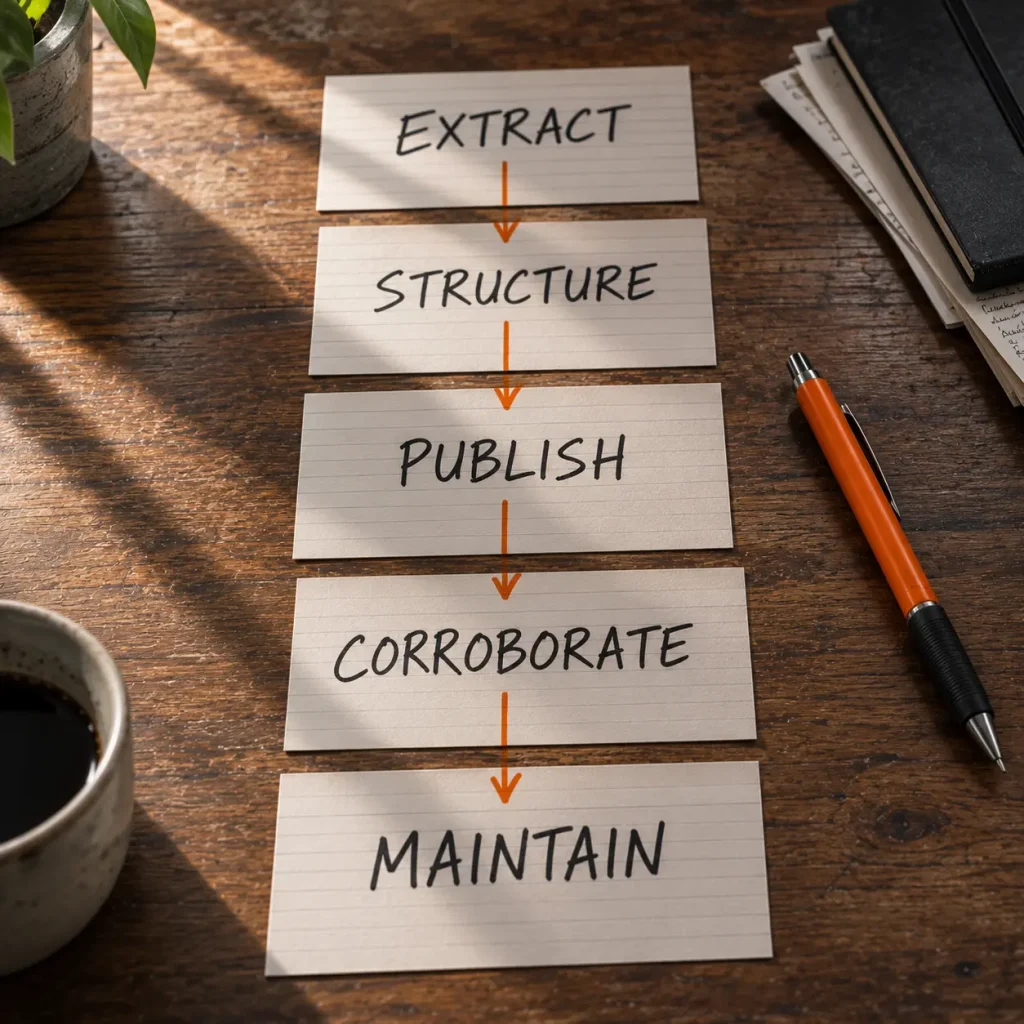
Five steps. Most of the work is step one.
Extract.
Get it out of your head. Structured interviews: what you do, for whom, how, what it costs, what you refuse, what happens when. Most of the work, and the part clients are most surprised by. You’re saying out loud, for the first time, things you’ve known for a decade.
Structure.
Turn prose into architecture. Services, entities, relationships, definitions, boundaries. Proper HTML with real headings, schema markup, tables, question-and-answer pairs. Not a PDF. Never a PDF.
Publish.
Public and crawlable. Knowledge in a client portal is knowledge no machine can vote on. Most of it lands on your site as real pages, which is exactly what AI search visibility needs.
Corroborate.
Hunt down every stale source and fix or kill it. Directories, old profiles, that PDF on your server, the guest post about work you don’t do. The step that actually changes what AI says about you: you’re removing the votes against you.
Maintain.
It goes stale the moment your business changes. A quarterly review, or you’re back here in two years.
A plain-language file at your root saying who you are, what you do, and where the canonical answers live. The note you leave for the machine describing you when you’re not in the room. It takes an afternoon.
what this unlocks
Unglamorous. And the foundation of three things you probably want.
Your chatbot stops hallucinating.
Bots don’t invent from nowhere. They invent when the knowledge base is thin. Every agent build I do starts here, because an agent is only as good as what it’s allowed to read.
AI search can name you.
You can’t be cited if there’s nothing citable. Visibility is downstream of this.
Automation becomes possible.
You can’t automate a process nobody has written down. Half of every automation project is discovering the process only exists as folklore.
People try to buy those three things directly. It’s like buying a roof before the walls. It’s also why so many chatbot projects quietly fail: the bot wasn’t the problem.
what it costs
See what AI says about you first. The build is quoted after.
start here · the sos digital diagnostic
Find out what AI currently says about you.
One fixed price. I find what’s wrong, fix what’s causing the damage, and tell you plainly what’s left. If anything beyond $997 is needed, you’ll see the scope and the cost first.
the source of truth build
Make your business AI-readable.
- Extraction: typically several hours of structured interview with you
- Structuring and publishing: a few weeks, depending on scope
- Corroboration cleanup: the slow part, depends on how many stale sources exist
frequently asked questions
The questions buyers actually ask.
Why does ChatGPT describe my business incorrectly?
Because it’s reporting the most corroborated version of you that exists publicly, and that version is usually years out of date. Every wrong detail almost always has a real source — an old directory listing, a stale PDF, an outdated profile. The model isn’t inventing things, it’s aggregating what’s out there. If the accurate version only lives in your head, it can’t be counted.
What is llms.txt and do I actually need one?
It’s a plain-text file at your website root telling AI systems who you are, what you do, and where your authoritative answers live — a summary written for machines rather than people. It’s cheap and takes an afternoon. It’s not a magic switch and adoption varies across AI systems, but it costs almost nothing and removes any excuse for being described badly.
Isn’t this just schema markup with a new name?
Schema is one component, not the whole job. Schema tells a machine what type of thing a page describes. AI-readability is about whether the knowledge exists at all, whether it’s structured, whether it’s public, and whether every source agrees. You can have perfect schema on a page that says nothing useful — plenty of sites do, and they’re invisible for exactly that reason.
Can you guarantee this will get me ranked or cited?
No, and I’d distrust anyone who says otherwise — there’s no submission form or ranking dial for AI systems. What this does is make you the most complete, consistent and readable source of truth about what you do, which is demonstrably what these systems are built to find and quote. That’s an honest edge rather than a guarantee, and in my experience genuinely deep material has always outlasted optimized thin material.
How long does this take and what do you need from me?
The extraction phase needs real time from you — typically several hours of structured interview, because the knowledge genuinely is in your head and there’s no shortcut around getting it out. Structuring and publishing takes a few weeks depending on scope. The corroboration cleanup is the slow part, since it depends on how many stale sources are out there and how cooperative each one is about being updated.
also in rebuild
Fix the foundation first.
write it down
She wasn’t defamed by a robot. She just never published a better version of herself.
So the machine used the one it could find, from 2021. Everything she needed was true, current, and locked in her head where nothing could read it.
One fixed price. I find what’s wrong, fix what’s causing the damage, and tell you plainly what’s left. If anything beyond $997 is needed, you’ll see the scope and the cost first.
About Stevie
I spent years knowing exactly what my business did and never once writing it down properly. Then my own website was taken over. It looked completely normal in my browser while tens of thousands of spam pages ran underneath it, and I had to take the whole thing down. With it went every trace of what I’d published, and I discovered how little of my business had ever existed anywhere but in my own head.
I rebuilt from a blank page. It taught me that undocumented knowledge isn’t knowledge. It’s a rumor with good intentions. I diagnose before I quote, because I know exactly what it costs to be certain about the wrong thing. The whole story is here.
sosSTEVIE: for when your digital presence is broken, invisible, or about to be.
Frequently asked questions
Why does ChatGPT describe my business incorrectly?
Because it's reporting the most corroborated version of you that exists publicly, and that version is usually years out of date. Every wrong detail almost always has a real source — an old directory listing, a stale PDF, an outdated profile. The model isn't inventing things, it's aggregating what's out there. If the accurate version only lives in your head, it can't be counted.
What is llms.txt and do I actually need one?
It's a plain-text file at your website root telling AI systems who you are, what you do, and where your authoritative answers live — a summary written for machines rather than people. It's cheap and takes an afternoon. It's not a magic switch and adoption varies across AI systems, but it costs almost nothing and removes any excuse for being described badly.
Isn't this just schema markup with a new name?
Schema is one component, not the whole job. Schema tells a machine what type of thing a page describes. AI-readability is about whether the knowledge exists at all, whether it's structured, whether it's public, and whether every source agrees. You can have perfect schema on a page that says nothing useful — plenty of sites do, and they're invisible for exactly that reason.
Can you guarantee this will get me ranked or cited?
No, and I'd distrust anyone who says otherwise — there's no submission form or ranking dial for AI systems. What this does is make you the most complete, consistent and readable source of truth about what you do, which is demonstrably what these systems are built to find and quote. That's an honest edge rather than a guarantee, and in my experience genuinely deep material has always outlasted optimized thin material.
How long does this take and what do you need from me?
The extraction phase needs real time from you — typically several hours of structured interview, because the knowledge genuinely is in your head and there's no shortcut around getting it out. Structuring and publishing takes a few weeks depending on scope. The corroboration cleanup is the slow part, since it depends on how many stale sources are out there and how cooperative each one is about being updated.
Also in Rebuild
Stop guessing.
One diagnosis. Find it, fix it, get back online. Small and medium sites are usually fully recovered within the $997.
The Site Rescue starts the moment your order is placed. I’ll email you within one business day, usually much sooner, to get access and book the 30-minute intake call. If the site is under attack right now, call (754) 302-4631 after you pay.
The Backstory
Two years ago my own website was taken over. It looked completely normal in my browser while tens of thousands of spam pages ran underneath it. I found out when the calls stopped, and I had to take the whole thing down.
I diagnose before I quote, because I know exactly what it costs to be certain about the wrong thing. The whole story is here.