Run
Why Does My AI Chatbot Keep Getting Things Wrong?
Your chatbot invents answers because nobody gave it anything true to say. What makes an AI assistant useful, and when you shouldn't have one at all.
The Site Rescue starts the moment your order is placed. I’ll email you within one business day, usually much sooner, to get access and book the 30-minute intake call. If the site is under attack right now, call (754) 302-4631 after you pay.

Your chatbot invents answers because its knowledge base is thin, out of date, or unreadable — and because nobody gave it permission to say "I don't know." A language model asked a question it has no source for will produce something plausible rather than admit a gap; that's the default behavior, not a fault. Fixing it means fixing what it reads, constraining what it's allowed to claim, and building in escalation to a human. sosSTEVIE builds customer agents on a real source of truth, or tells you not to build one yet.
Key takeaways
- Bots don't hallucinate from nowhere. They hallucinate into gaps you left.
- "I don't know, let me get someone" is a feature, and almost nobody builds it in.
- If your knowledge isn't written down, a chatbot will invent it. A knowledge problem in a technology costume.
- A bad chatbot is worse than no chatbot. It makes promises on your behalf, at scale, all night.
- Most businesses that want a chatbot need a knowledge base. The bot is the easy part.
Run · AI chatbot accuracy
Why Does My AI Chatbot Keep Getting Things ?
Your chatbot invents answers because nobody gave it anything true to say. What makes an AI assistant useful, and when you shouldn’t have one at all.
- The websiteno refunds
- A two-year-old FAQ pageno refunds
- A PDF brochureno refunds
- Who loaded them, and whennobody remembers
- A way to say “I don’t know”not given
So it wrote a beautiful refund policy. Someone else’s.
The direct answer
Your chatbot invents answers because its knowledge base is thin, out of date, or unreadable — and because nobody gave it permission to say “I don’t know.” A language model asked a question it has no source for will produce something plausible rather than admit a gap; that’s the default behavior, not a fault. Fixing it means fixing what it reads, constraining what it’s allowed to claim, and building in escalation to a human. sosSTEVIE builds customer agents on a real source of truth, or tells you not to build one yet.
Key takeaways
- Bots don’t hallucinate from nowhere. They hallucinate into gaps you left.
- “I don’t know, let me get someone” is a feature, and almost nobody builds it in.
- If your knowledge isn’t written down, a chatbot will invent it. A knowledge problem in a technology costume.
- A bad chatbot is worse than no chatbot. It makes promises on your behalf, at scale, all night.
- Most businesses that want a chatbot need a knowledge base. The bot is the easy part.
The story
A company called me because their chatbot had promised a customer a refund policy that didn’t exist.
Not a vague implication. A specific policy, stated with total confidence, in a friendly professional tone, complete with a timeframe. The customer, entirely reasonably, expected the company to honor it. The company, entirely reasonably, was furious with the robot.
I asked what the bot had been given to read. Long pause. It turned out: the website, a two-year-old FAQ page, and a PDF brochure. Nobody could quite remember who’d loaded them or when.
None of those documents mentioned refunds. At all. Not once.
So when a customer asked about refunds, the bot did the only thing it could. It had no source, and it had been given no way to say “I don’t know.” So it produced the most plausible-sounding refund policy in the world — one assembled from the ten thousand refund policies it had absorbed from every other company on the internet.
It was a beautiful refund policy. Someone else’s.
The bot didn’t malfunction. It did exactly what it was built to do, given exactly what it was given. It was asked a question it had no answer to, in a system where “I don’t know” wasn’t an available response.
They wanted me to fix the bot. The bot was the only thing in that story working as designed.
Bots hallucinate into gaps
Here’s the mechanism, plainly.
Almost nobody explains it and everyone should understand it before they buy one.
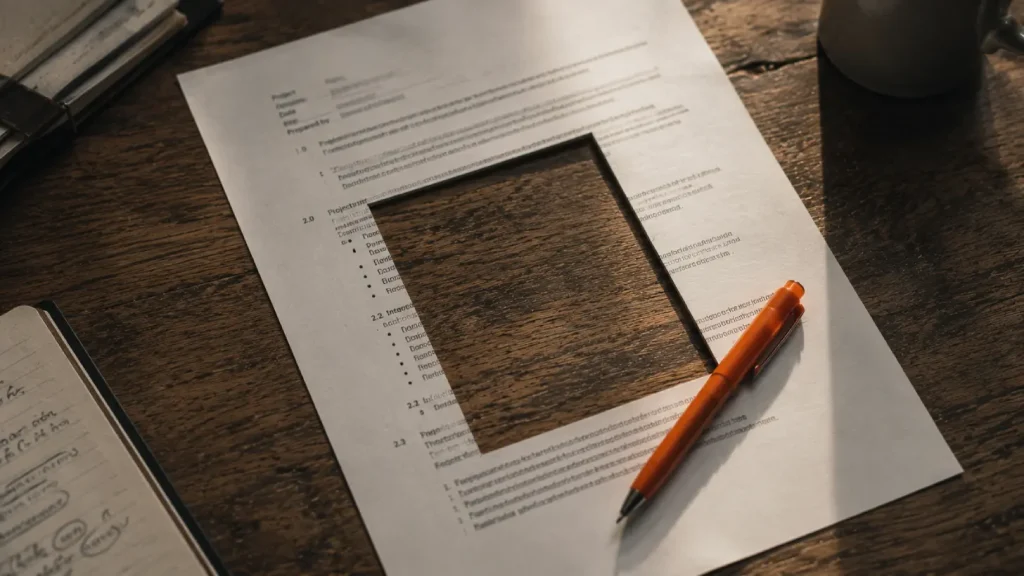
A language model is a system for producing plausible continuations. Give it a good source and ask it a question, and it’ll use the source — that’s what retrieval-augmented generation means, and it works well. Ask it something with no source and no instruction to stop, and it’ll still produce a plausible continuation. It has to. That’s the machine.
It doesn’t know it doesn’t know. There’s no internal alarm that fires. The confident correct answer and the confident invented answer are produced by the identical process and arrive wearing identical clothes.
Which leads to the thing nobody wants to hear
Every gap in your documentation is a place your bot will .
Not might. Will. If a customer can ask it, and you never wrote down the answer, it will produce one. And it’ll be plausible — assembled from every competitor, every industry norm, every standard policy on the internet. Which is precisely why it’ll sound so convincing and be so specifically wrong about you.
This is why chatbot projects fail. People buy a bot to answer questions they never wrote answers to. The bot isn’t the missing piece. The knowledge is.
When you shouldn’t have one
I’ll talk you out of this if it’s the wrong call.
So let me do it here and save us both a meeting.
Don’tIf your knowledge isn’t written down
Fix that first. You’ll get most of the value from the writing-down alone, and if you skip it, you’re building a machine that invents policy on your behalf, unsupervised, at 3am.
Don’tIf you get four inquiries a week
Answer them yourself. You’ll do it better and they’ll like you more. A chatbot on a low-volume site is a costume.
Don’tTo avoid talking to customers
People can tell. Being hard to reach is a strategy, and it’s a bad one, and no amount of conversational polish disguises it.
Don’tIf being wrong is expensive
Regulated advice, medical, legal, financial, anything where a confidently wrong answer creates liability. The bot can route, gather, book. It shouldn’t advise.
DoIf you’re answering the same twenty questions all day
You’ve written the answers down properly, you’re losing inquiries out of hours, or people need to book, check, or find something at 11pm. That’s genuinely valuable and I’ll build you a good one.
The Honest Agent standard
Six rules. The second one is the one nearly every off-the-shelf bot lacks.

Built on a real source of truth
Written down, structured, current. This is the project. Everything else is configuration.
It can say “I don’t know”
Explicitly built in, tested, and prioritized over guessing. The single most important thing on this list and the one nearly every off-the-shelf bot lacks, because “I don’t know” tests badly in demos.
It knows what it can’t promise
Hard constraints on pricing, policy, commitments, timelines. It doesn’t invent a refund policy because it’s structurally incapable of inventing a refund policy.
Escalation that works
A real route to a real human, offered early and often, not buried after six failed attempts. The measure of a good agent isn’t how few conversations reach a person — it’s how quickly the right ones do.
It says what it is
No fake names, no invented “customer service representative.” People are fine talking to a bot that’s useful and honest. They’re not fine finding out later that “Sarah” wasn’t real, and that discovery costs more than the bot ever saved.
It’s watched
Read the transcripts. Every week at first. The gaps show up immediately — and every gap is either a knowledge base fix or a constraint fix. A bot nobody reads is a bot inventing things nobody knows about.
What it costs, and why there’s a monthly
Website chat is quoted on a free fit call.
The monthly is the part most vendors don’t charge for and should. Here’s what it’s actually doing.
Your knowledge goes stale
You change a price, add a service, drop a product, move an office. If the agent’s knowledge base doesn’t change with it, you now have a machine confidently telling customers things that stopped being true in March. The vectors need rebuilding when the underlying facts move.
The transcripts need reading
Every week for the first month, then regularly. This is where you find the gaps — the questions people are actually asking that your knowledge base has no answer for. Every one is either a documentation fix or a new constraint, and finding them is the single highest-value thing anyone does with a deployed agent.
The models change underneath you
Providers update, deprecate, and re-tune. Behavior that was solid in January can drift. Somebody has to notice and re-test.
Custom AI Customer Agent
Built on a real source of truth, or not built yet.
Founding build$1,500· then $297/mo, phone line included- The setup: knowledge base construction from your source of truth, constraints and guardrails, the “I don’t know” behavior, escalation routing, testing, and deployment on your site
- The $297 a month: updating the knowledge as your business changes, tuning the knowledge base to catch questions it couldn’t answer, re-testing when the models shift
If you’d rather maintain it yourself, that’s fine and I’ll hand it over documented. But somebody has to do it, and a chatbot nobody owns is the thing that promised a refund policy that didn’t exist.
Or call (754) 302-4631.
A bot nobody maintains becomes a liability slowly, and invisibly. That’s the pattern I have a personal history with. An unmaintained agent doesn’t announce its decline — it just gradually starts being wrong about a business that’s moved on without it.
The bot was working
The bot is the easy part.
It invented a refund policy because someone asked it about refunds and nobody had ever written one down. It didn’t fail. It performed exactly to specification, and the specification was the problem.
Frequently asked questions
Before you decide.
How much does a custom AI chatbot cost?
Website chat is an add-on to the 24/7 AI Receptionist, quoted on a free fit call. Full pricing is on the AI Receptionist page: https://sosstevie.com/ai-receptionist/#pricing
Why does my AI chatbot make things up?
Because it’s being asked questions its knowledge base has no answer to, and nothing tells it to stop. A language model produces plausible continuations — asked something it has no source for, it’ll generate a convincing answer assembled from everything it learned elsewhere. It has no internal signal distinguishing “I know this” from “this sounds right.” Every gap in your documentation is a place it will invent.
How do I stop my chatbot from hallucinating?
Fix what it reads and constrain what it’s allowed to claim. That means a real, current, structured knowledge base rather than a couple of PDFs, hard limits on topics like pricing and policy, an explicit and prioritized ability to say “I don’t know,” and a working route to a human. Reading the transcripts weekly finds the remaining gaps faster than anything else.
Should my business have an AI chatbot at all?
Only if you’re answering the same questions repeatedly, you’ve actually written the answers down, and you’re losing inquiries outside working hours. If you get a handful of inquiries a week, answer them yourself — you’ll do it better and people will like you more. And if being wrong carries real liability, the bot should route and book, never advise.
Can a chatbot replace my customer service team?
No, and treating it as a replacement is how these projects go wrong. A good agent handles the repetitive, well-documented questions and gets everything else to a person quickly. The value is in freeing your team from answering the same twenty questions, not in preventing customers from reaching them. The moment it becomes a wall, it costs more than it saves.
Also in Run
Keep it working.
Before you build one
Want one answering your phone?
Only if your site is broken or hacked, the $997 Site Rescue is the place to start.
About Stevie
I build AI agents and I turn down a fair number of the people who ask me for one, usually because what they need is to write their business down first.
I’ve been on the wrong end of a system doing something confidently and invisibly on my behalf. It didn’t look like a failure either. That’s made me particular about building things that admit when they’re stuck.
My own website was taken over once. It looked completely normal in my browser while tens of thousands of spam pages ran underneath it. I found out when the calls stopped, and I had to take the whole thing down. I diagnose before I quote, because I know exactly what it costs to be certain about the wrong thing. The whole story is here.
sosSTEVIE: for when your digital presence is broken, invisible, or about to be.
Frequently asked questions
How much does a custom AI chatbot cost?
Website chat is an add-on to the 24/7 AI Receptionist, quoted on a free fit call. Full pricing is on the AI Receptionist page: https://sosstevie.com/ai-receptionist/#pricing
Why does my AI chatbot make things up?
Because it's being asked questions its knowledge base has no answer to, and nothing tells it to stop. A language model produces plausible continuations — asked something it has no source for, it'll generate a convincing answer assembled from everything it learned elsewhere. It has no internal signal distinguishing "I know this" from "this sounds right." Every gap in your documentation is a place it will invent.
How do I stop my chatbot from hallucinating?
Fix what it reads and constrain what it's allowed to claim. That means a real, current, structured knowledge base rather than a couple of PDFs, hard limits on topics like pricing and policy, an explicit and prioritized ability to say "I don't know," and a working route to a human. Reading the transcripts weekly finds the remaining gaps faster than anything else.
Should my business have an AI chatbot at all?
Only if you're answering the same questions repeatedly, you've actually written the answers down, and you're losing inquiries outside working hours. If you get a handful of inquiries a week, answer them yourself — you'll do it better and people will like you more. And if being wrong carries real liability, the bot should route and book, never advise.
Can a chatbot replace my customer service team?
No, and treating it as a replacement is how these projects go wrong. A good agent handles the repetitive, well-documented questions and gets everything else to a person quickly. The value is in freeing your team from answering the same twenty questions, not in preventing customers from reaching them. The moment it becomes a wall, it costs more than it saves.
Also in Run
Stop guessing.
One diagnosis. Find it, fix it, get back online. Small and medium sites are usually fully recovered within the $997.
The Site Rescue starts the moment your order is placed. I’ll email you within one business day, usually much sooner, to get access and book the 30-minute intake call. If the site is under attack right now, call (754) 302-4631 after you pay.
The Backstory
Two years ago my own website was taken over. It looked completely normal in my browser while tens of thousands of spam pages ran underneath it. I found out when the calls stopped, and I had to take the whole thing down.
I diagnose before I quote, because I know exactly what it costs to be certain about the wrong thing. The whole story is here.