Run · from $1,495
What Should I Automate First in My Business?
Not the thing you hate most. And not until somebody's written down how it actually works — which, I promise you, nobody has.
The Site Rescue starts the moment your order is placed. I’ll email you within one business day, usually much sooner, to get access and book the 30-minute intake call. If the site is under attack right now, call (754) 302-4631 after you pay.

Automate the highest-volume, most rule-based, lowest-judgment task you have — and only after the process is written down. Most automation projects fail not on the technology but because the process only exists as folklore in someone's head, so there's nothing to automate. Start with data moving between systems, then notifications, then rule-based decisions. Never start with the thing you hate most, because you usually hate it precisely because it needs judgment. sosSTEVIE writes the process down first, then automates it, from $1,495.
Key takeaways
- If nobody's written the process down, you don't have a process. You have a person, and you should ask them.
- The thing you hate most is usually the worst candidate. You hate it because it requires judgment.
- Automation projects fail on process clarity, not technology. The tools are all fine.
- A broken automation is worse than no automation, because it fails silently and confidently.
- The documentation is often worth more than the automation. Jessica retires.
Run · from $1,495
What Should I Automate in My Business?
Not the thing you hate most. And not until somebody’s written down how it actually works — which, I promise you, nobody has.
- Which clients are the awkward ones?Jessica knows
- This one always negotiatespad it
- That one pays latetake a deposit
- A friend of the ownerno minimum
- In the CRM?none of it
- Years doing it this wayeleven
There was no quoting process. There was Jessica.
The direct answer
Automate the highest-volume, most rule-based, lowest-judgment task you have — and only after the process is written down. Most automation projects fail not on the technology but because the process only exists as folklore in someone’s head, so there’s nothing to automate. Start with data moving between systems, then notifications, then rule-based decisions. Never start with the thing you hate most, because you usually hate it precisely because it needs judgment. sosSTEVIE writes the process down first, then automates it, from $1,495.
Key takeaways
- If nobody’s written the process down, you don’t have a process. You have a person, and you should ask them.
- The thing you hate most is usually the worst candidate. You hate it because it requires judgment.
- Automation projects fail on process clarity, not technology. The tools are all fine.
- A broken automation is worse than no automation, because it fails silently and confidently.
- The documentation is often worth more than the automation. Jessica retires.
The story
Someone asked me to automate their quoting process. They hated it.
Four hours a week, tedious, error-prone, obviously a machine’s job. Straightforward. So I asked them to walk me through it, and about ninety seconds in, it fell apart.
“Well, it depends on the client.” Which clients? “You know — the awkward ones.” Awkward how? “Jessica knows.”
Jessica knew. Jessica had been doing it for eleven years. Jessica looked at the client name and just knew — that this one always negotiates so you pad it, that one pays late so you take a deposit, this other one’s a friend of the owner so you don’t apply the minimum. None of it written anywhere. None of it in the CRM. All of it correct, and all of it load-bearing.
There was no quoting process. There was Jessica, and a spreadsheet that recorded what Jessica had decided.
You cannot automate that. Not because it’s hard — because it doesn’t exist in a form anything can execute. The four hours a week weren’t the process. They were Jessica thinking.
So we spent two weeks writing down what Jessica knew. That was the project. The automation itself took three days afterwards, and it worked — and it worked because for the first time in eleven years, somebody had asked Jessica how she does it.
Then Jessica retired last year, and they still have her judgment. That turned out to be worth vastly more than the four hours.
Where the time actually went
Discovery wasn’t a formality. It was the project.
Automation is mostly just asking people how they do their job.
Everything after that is plumbing.
Why automation projects fail
Not the tools. The tools are fine.
Zapier, Make, n8n — arguing about them is a distraction people use to avoid the real problem.
The process doesn’t exist
Every business believes it has processes. What it usually has is a set of habits, several undocumented exceptions, and two or three people who know things nobody has ever asked them. That works — it works beautifully, actually — right up until you try to hand it to a machine, and the machine asks the questions nobody’s asked in a decade.
The wrong thing first
They pick the task they hate. But you hate it because it’s fiddly and requires judgment, which makes it the hardest thing to automate and the most dangerous to get wrong. The right first target is usually something boring you barely notice — copying data between two systems, because it happens two hundred times a month and needs no thought whatsoever.
They fail silently
A broken workflow doesn’t throw an error into anyone’s face. It just stops, and nobody notices for six weeks, and by then there are four hundred records that never synced. Every automation needs to be able to tell you it’s broken. Almost none do.
That’s the moment automation projects die. Everyone assumed the discovery phase was a formality. It wasn’t. I have a personal thing about silent failure — I lost a business to one.
The Automation Ladder
Climb in order.
Skipping rungs is how you end up with an expensive, confident, wrong system.
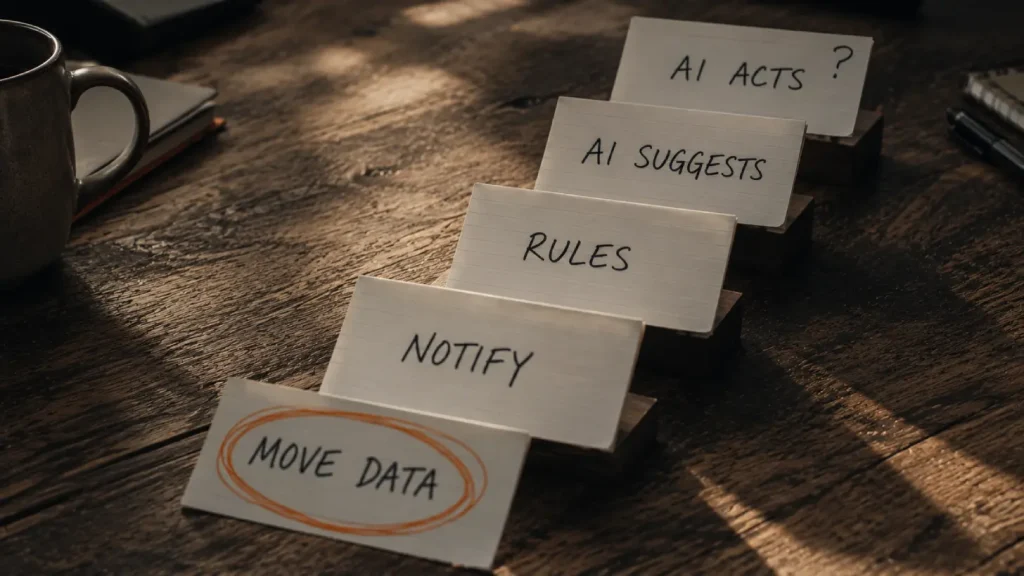
Rung 1Move data
System A to System B. No decisions, no judgment. Boring, high-volume, immediately valuable, almost impossible to get wrong. Start here even if it feels too small. Especially if it feels too small.
Rung 2Notify
Tell the right person when something happens. Still no decisions. Removes the “did anyone follow up?” tax.
Rung 3Rule-based decisions
If this, then that — where the rules are genuinely explicit and you can write them all down. This is where Jessica lives, and where the writing-down happens. Most of the value in most businesses is on this rung.
Rung 4 · the sweet spotAI judgment, with a human deciding
The model reads, classifies, drafts, suggests. A person approves. This is the sweet spot right now for almost every small business — most of the speed, none of the exposure.
Rung 5AI agents that act
The system takes real action without asking. Genuinely powerful, genuinely risky, and appropriate far less often than the market suggests. Only for reversible actions, with hard limits and logging, once rungs 1–4 are solid.
Almost everyone wants to start at rung 5, because rung 5 is what’s on LinkedIn. Almost everyone should start at rung 1.
The money is on rungs 1–4 and it always has been.
Let me be honest about agents
The most oversold thing in this industry right now, and I say that as someone who builds them.
They work. When the process is well-defined, the actions are reversible, the limits are hard, and there’s logging, they’re genuinely transformative.
They fail badly when any of that isn’t true — and they fail confidently, which is the problem. A broken script stops. An agent keeps going, doing something plausible and wrong, at machine speed, until somebody notices. That’s a different category of risk and it deserves to be treated like one.
- Reversible actions only, unless there’s a human approving. An agent can draft the email. It doesn’t send the invoice.01
- Hard limits. Money, volume, scope. Enforced in the system, not in the prompt. A prompt is a request; a system limit is a wall.02
- Everything logged. If you can’t reconstruct what it did and why, you don’t have a system, you have a rumor.03
- It must be able to say it’s stuck. Nothing that guesses when it doesn’t know.04
- Rungs 1–4 first. Always.05
If that sounds conservative for someone selling AI automation — I got taken apart once by a system doing something confidently and invisibly on my behalf. It’s shaped how I build. I’d rather tell you that up front than after.
On tools
The tool is the last decision, and the one.
People want me to say n8n. Sometimes it’s n8n — it’s excellent, self-hostable, cheaper at scale, and better when data privacy is a real constraint. Sometimes it’s Zapier, because you need two connections and no maintenance burden. Sometimes it’s Make. Sometimes it’s forty lines of code and no platform at all.
Choosing the platform before you understand the process is choosing a van before you know what you’re moving.
Anyone who tells you their preferred tool before asking what you do is selling you their preferred tool.
What it costs
From $1,495, scaling with process complexity.
The bigger variable isn’t the automation. It’s how much of the process already exists in writing. If it’s documented, we build. If it’s Jessica, we’re spending two weeks on discovery first, and that’s the honest quote.
AI Workflow Automation
Write the process down. Then automate it.
- The entry point: a well-defined, single-process automation — the rung 1 or rung 2 work that most businesses should start with
- Multi-system workflows, real decision logic, or anything on rungs 3 and 4 costs more, and I’ll scope it before starting rather than after
- If the process lives in someone’s head, discovery comes first, quoted separately and honestly
Process documentation
Available on its own, without any automation attached.
Sometimes that’s the right purchase — you get a written, owned, transferable record of how your business actually runs, and you might discover you don’t need the automation at all.
That’s a legitimate outcome and I’d rather sell it to you than build something you don’t need.
Frequently asked questions
Before you decide.
What should I automate first?
The highest-volume, most rule-based, lowest-judgment task you have — usually something boring like moving data between two systems hundreds of times a month. Don’t start with the task you hate most; you almost certainly hate it because it needs judgment, which makes it the hardest and riskiest thing to automate. Start where success is boring and guaranteed.
How much does business automation cost?
Mine starts at $1,495 for a well-defined single-process automation, scaling with complexity. The biggest variable isn’t the build — it’s whether your process is already written down. If it lives in someone’s head, expect discovery work before any automation, and I’ll quote that separately and honestly rather than discovering it halfway through.
Why do so many automation projects fail?
Because the process was never written down, so there was nothing to automate. Most businesses have habits and undocumented exceptions rather than processes, plus a couple of people who know things nobody’s ever asked them. The technology is rarely the problem — discovery is the project, and it’s routinely mistaken for a formality.
Should I use Zapier, Make or n8n?
It depends on what you’re doing, and the tool is the last decision, not the first. n8n is excellent when you want self-hosting, lower costs at scale, or genuine data privacy control. Zapier is right when you need a couple of reliable connections and no maintenance burden. Anyone who names a tool before asking what your process is, is selling you their favorite.
Is it safe to let AI take actions automatically?
Sometimes, with real constraints. Autonomous agents should only take reversible actions unless a human is approving, need hard limits enforced in the system rather than in a prompt, need full logging, and must be able to say when they’re stuck rather than guess. The danger isn’t that they fail — it’s that they fail confidently and quietly, at speed, until somebody notices.
Ask Jessica first
Let’s find out what you actually do.
Writing that down took two weeks. The automation took three days. And when Jessica retired, they still had what she knew — which turned out to be the actual asset, and the thing nobody had thought to ask for.
One fixed price. I find what’s wrong, fix what’s causing the damage, and tell you plainly what’s left. If anything beyond $997 is needed, you’ll see the scope and the cost first.
About Stevie
I automate things for a living and I’m more cautious about it than most people selling this, for a specific reason: I lost a business to a system that was doing something confidently, invisibly, and wrong, on my behalf, for weeks.
So I build things that tell you when they’re stuck. It’s not the exciting pitch. It’s the one I’d want.
My own website was taken over once. It looked completely normal in my browser while tens of thousands of spam pages ran underneath it. I found out when the calls stopped, and I had to take the whole thing down. I diagnose before I quote, because I know exactly what it costs to be certain about the wrong thing. The whole story is here.
sosSTEVIE: for when your digital presence is broken, invisible, or about to be.
Frequently asked questions
What should I automate first?
The highest-volume, most rule-based, lowest-judgment task you have — usually something boring like moving data between two systems hundreds of times a month. Don't start with the task you hate most; you almost certainly hate it because it needs judgment, which makes it the hardest and riskiest thing to automate. Start where success is boring and guaranteed.
How much does business automation cost?
Mine starts at $1,495 for a well-defined single-process automation, scaling with complexity. The biggest variable isn't the build — it's whether your process is already written down. If it lives in someone's head, expect discovery work before any automation, and I'll quote that separately and honestly rather than discovering it halfway through.
Why do so many automation projects fail?
Because the process was never written down, so there was nothing to automate. Most businesses have habits and undocumented exceptions rather than processes, plus a couple of people who know things nobody's ever asked them. The technology is rarely the problem — discovery is the project, and it's routinely mistaken for a formality.
Should I use Zapier, Make or n8n?
It depends on what you're doing, and the tool is the last decision, not the first. n8n is excellent when you want self-hosting, lower costs at scale, or genuine data privacy control. Zapier is right when you need a couple of reliable connections and no maintenance burden. Anyone who names a tool before asking what your process is, is selling you their favorite.
Is it safe to let AI take actions automatically?
Sometimes, with real constraints. Autonomous agents should only take reversible actions unless a human is approving, need hard limits enforced in the system rather than in a prompt, need full logging, and must be able to say when they're stuck rather than guess. The danger isn't that they fail — it's that they fail confidently and quietly, at speed, until somebody notices.
Also in Run
Stop guessing.
One diagnosis. Find it, fix it, get back online. Small and medium sites are usually fully recovered within the $997.
The Site Rescue starts the moment your order is placed. I’ll email you within one business day, usually much sooner, to get access and book the 30-minute intake call. If the site is under attack right now, call (754) 302-4631 after you pay.
The Backstory
Two years ago my own website was taken over. It looked completely normal in my browser while tens of thousands of spam pages ran underneath it. I found out when the calls stopped, and I had to take the whole thing down.
I diagnose before I quote, because I know exactly what it costs to be certain about the wrong thing. The whole story is here.