Rank
Why Isn't My AI-Written Content Getting Any Traction?
Because it doesn't know anything. You can generate a hundred posts a month and say nothing a hundred times. The problem isn't the AI. It's that you have nothing to say and it shows.
The Site Rescue starts the moment your order is placed. I’ll email you within one business day, usually much sooner, to get access and book the 30-minute intake call. If the site is under attack right now, call (754) 302-4631 after you pay.
Your AI-written content isn't working because AI has no information about your business — it can only recombine what everyone already published, so you get competent, correct, weightless content that says what everyone says. Content earns attention through information nobody else has: your data, your mistakes, your specific opinions, your actual client outcomes. sosSTEVIE builds content engines that start by extracting what only you know, then use AI to produce and adapt it at pace. The machine handles the volume. The information has to come from you.
Key takeaways
- AI doesn't make content bad. It makes average content instant, and average content was never working.
- Anything a model can write without asking you a question is something everyone already has.
- Google doesn't penalise AI writing. It has always devalued content with nothing in it.
- Volume without information is the fastest way to bore an audience at scale.
- The bottleneck was never writing. It was having something to say, and AI didn't touch that.
~/rank/content-engine · information first
Rank · Quoted after the Site Rescue
Why Isn’t My AI-Written Content Getting Any Traction?
Because it doesn’t know anything. You can generate a hundred posts a month and say nothing a hundred times. The problem isn’t the AI. It’s that you have nothing to say and it shows.
report --last-5-months
posts published92 (before AI: about 1 a quarter)
trafficflat
inquiries0. not low. zero
original posts0
still unpublished1 lost shipment, 2019. the real article
answer
Your AI-written content isn’t working because AI has no information about your business — it can only recombine what everyone already published, so you get competent, correct, weightless content that says what everyone says. Content earns attention through information nobody else has: your data, your mistakes, your specific opinions, your actual client outcomes. sosSTEVIE builds content engines that start by extracting what only you know, then use AI to produce and adapt it at pace. The machine handles the volume. The information has to come from you.
key takeaways
- AI doesn’t make content bad. It makes average content instant, and average content was never working.
- Anything a model can write without asking you a question is something everyone already has.
- Google doesn’t penalise AI writing. It has always devalued content with nothing in it.
- Volume without information is the fastest way to bore an audience at scale.
- The bottleneck was never writing. It was having something to say, and AI didn’t touch that.
the story
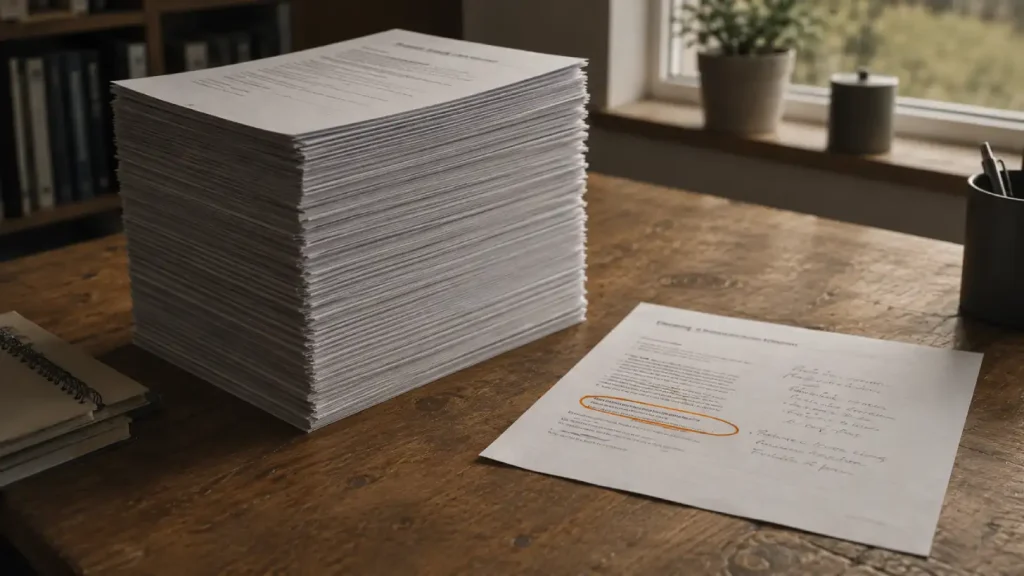
Ninety-two blog posts in five months. Traffic: flat.
A man showed me his content programme with real pride, and I felt genuinely sorry for what I was about to say. Before AI he’d managed about one post a quarter. Now he had a calendar, a pipeline, a system. He’d cracked it.
Inquiries from content: zero. Not low. Zero.
I read six posts. Every one was competent. Grammatical, well-structured, on-topic, and utterly weightless. “5 Ways To Improve Your Supply Chain.” “The Importance Of Quality Control.” Ninety-two pieces that could have been published by any of his competitors, because there was nothing in any of them that only he could have written.
Then we talked for twenty minutes, and he told me, offhandedly, as an aside, not knowing he was saying anything, about a shipment he’d lost in 2019, the specific mistake that caused it, what he’d changed in his business because of it, and how he now checks one particular thing that nobody else in his industry checks.
That’s an article. That’s an article nobody else on earth can write. It was sitting in his head, unpublished, for six years, while a machine produced ninety-two pieces about the importance of quality control.
He didn’t have a content problem. He had a nobody asked him anything problem.
everyone’s saying the same things faster
The cost of a competent article went to roughly zero. For everyone.
Which is genuinely wonderful, and also means your competitors’ cost went to zero too. So everyone published more.
Sources: post and blog counts are industry estimates commonly cited by Internet Live Stats and repeated across the sector. Treat them as directional rather than precise: nobody can audit the whole web, but the direction isn’t in dispute, and it’s up. The 96% figure is from Ahrefs’ large-scale index studies, which have repeatedly found it.
Read those together. Millions of pages published daily, and almost all of them invisible. The overwhelming default outcome for a published page is that nothing happens to it. Those ninety-two posts weren’t unlucky. They landed exactly where the distribution says they would.
the mechanism people miss
A language model can only tell you what has already been said.
That’s not a flaw, that’s what it is. If a model can write your article without asking you a single question, that article contains no information that wasn’t already public, which means, definitionally, that your competitors already have it.
You didn’t create an asset. You created a copy of something that already existed, and paid for hosting.
Meanwhile, the stuff that would actually work, your numbers, your failures, your specific contrarian view, what actually happened with that client in March, is in your head, and nobody asked.

the google question
“Will Google penalise me for using AI?” No. That’s the misleading part.
| The comforting answer | The real version | |
|---|---|---|
| ai writing | Google cares about content quality, not production method. It doesn’t penalise AI writing. | Google has always devalued content with nothing in it. That’s not new and it’s not about AI. |
| what changed | Nothing about the rules. | Empty content is now free to produce, so people produce mountains of it, then blame the algorithm when the mountain doesn’t rank. |
| the penalty | There isn’t one for using AI. | The penalty is for having nothing to say. The same one that’s always existed. AI just removed the effort that used to stop people. |
Ninety-two posts of nothing rank exactly as well as one post of nothing.
the information first method
Seven steps. AI does the typing. Not the thinking.
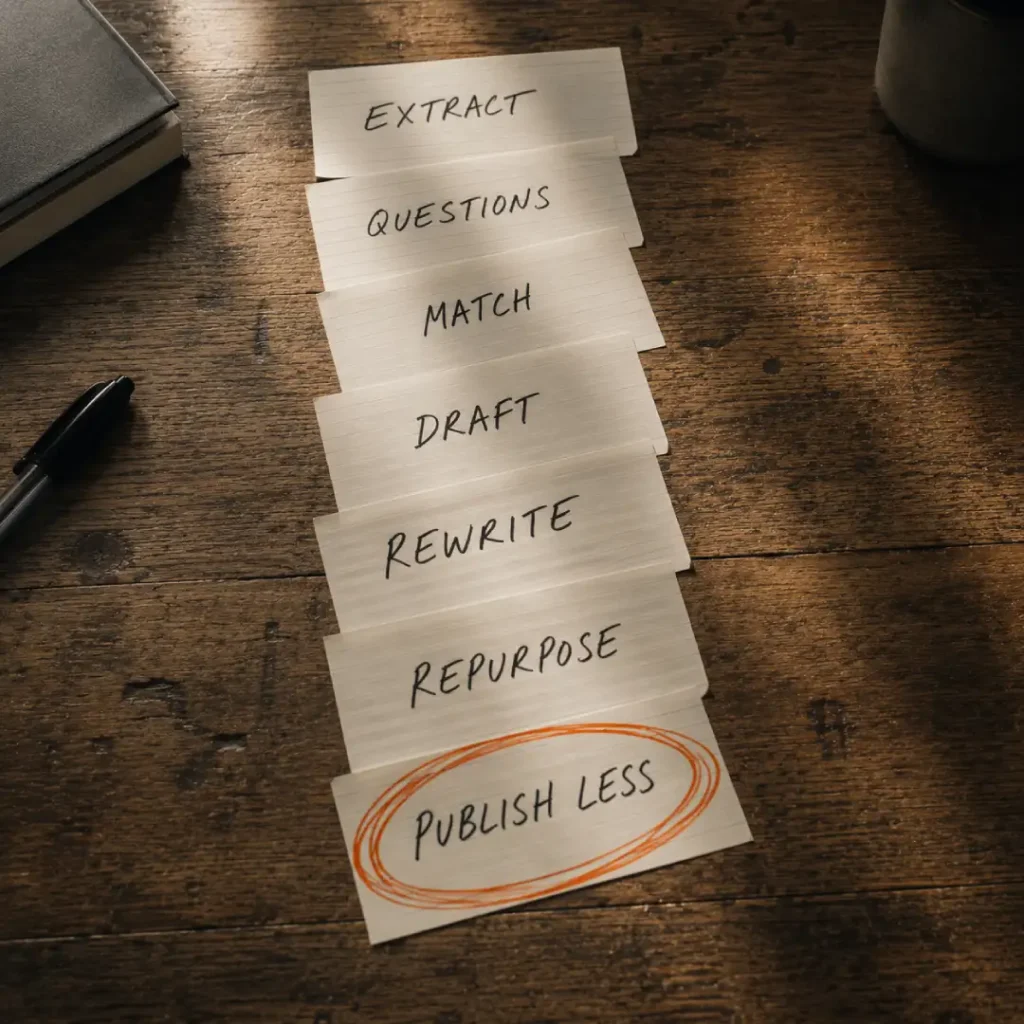
Extract.
Before anything gets written, get what only you know out of your head: the losses, the numbers, the opinions you’re slightly nervous about publishing, the thing you always end up explaining on sales calls. Structured interviews, recorded. The same extraction that makes you AI-readable, which is why these two belong together. This is the hard part and the whole product. Everything downstream is logistics.
Find the questions.
Not keywords. Questions. The actual sentences your buyers say, on calls, in emails, at the moment they’re deciding. Each becomes a piece.
Match information to question.
Where do you have something nobody else has? Those are your pieces. If you have nothing on a topic, don’t publish on it. Silence beats noise. An empty slot in the calendar is not a failure.
Now use AI, hard.
Structure, draft, adapt, tighten, and produce the visuals. This is where it’s genuinely brilliant and saves you most of the work. It is doing the typing. It is not doing the thinking, and the moment those swap, you’re back to ninety-two posts of nothing.
Put you back in.
The first draft will be smooth and slightly dead. Your job is the specific number, the actual name, the sentence a machine wouldn’t risk. Twenty minutes, and it’s the difference.
Repurpose properly.
One real idea becomes a post, a video, five social pieces, a section of a sales conversation. Not by pasting it across platforms: by rewriting it for each. Lazy repurposing is visible and worse than not bothering.
Publish less than you can.
You can now produce a hundred pieces a month. Don’t. Publish what has information in it. That’s probably four.
before you publish
Could a model have written it without asking you a question?
Take your next draft. Tick what it actually contains. Every item comes from the method above.
about brand voice
Voice is what you’re willing to say that others aren’t.
Brand voice isn’t a document of adjectives. Nobody has ever been helped by “friendly but professional, authoritative yet approachable.”
It’s your actual positions. The thing you’d argue about at a conference. A voice guide that doesn’t contain at least one opinion your competitor would refuse to publish isn’t a voice guide, it’s a style sheet, and a model given a style sheet will produce something smooth, safe and forgettable, because you asked for exactly that.
I do build voice systems, and they work. They work because we start with what you believe, not how you sound.
and on ai personas
Be careful. There’s a real line between using AI to scale your voice and using AI to fake a person who isn’t there. Cross it and you’ll be found out, and the finding out costs more than everything you saved.
The one place you can’t afford to sound automated is anywhere someone’s trying to work out if you’re real.
what anyone can control
I can get the information out of you. Nobody can promise it ranks.
No traffic promises. Just the part that decides whether a piece has a chance: whether there’s anything in it.
in our control
What goes into every piece.
- The extraction. What only you know, recorded and structured.
- The questions. Your buyers’ real sentences, not a keyword list.
- What gets published. Only pieces with information in them. Fewer of them.
- The rewrite. You, back in every draft.
in nobody’s control
What happens after you hit publish.
- How Google ranks it. Its systems, its schedule.
- Whether an AI answer quotes it. No submission form, no dial.
- How much everyone else publishes. Millions of pages a day.
- A traffic guarantee. Anyone offering one is guessing.
what it costs
Find out what you know first. The engine is quoted after.
start here · the sos digital diagnostic
Let’s find out what you know.
One fixed price. I find what’s wrong, fix what’s causing the damage, and tell you plainly what’s left. If anything beyond $997 is needed, you’ll see the scope and the cost first.
the content engine
Information First, built for your business.
- Structured extraction interviews, recorded
- The questions your buyers actually ask
- AI production and adaptation at pace
- Voice system built from what you believe
frequently asked questions
The questions buyers actually ask.
Does AI-generated content rank on Google?
Yes. Google has been clear that it evaluates content quality, not how it was produced, and AI-assisted content ranks perfectly well when it’s genuinely useful. What doesn’t rank is content with no information in it — and that’s not a rule about AI, it’s a rule that’s always existed. AI simply made empty content free to produce, so there’s far more of it now.
Why is my AI-written content getting no traffic?
Almost certainly because it contains nothing that wasn’t already published elsewhere. If a model wrote your article without asking you anything, everything in it was already public, so you’ve produced a copy of content that already exists. Ahrefs’ research has found roughly 96% of pages get no Google traffic at all — that’s the default outcome, and only genuinely new information escapes it.
How do I make AI content actually sound like me?
Start with what you believe rather than how you sound. Most voice guides list adjectives, which produces smooth generic output because that’s exactly what was asked for. Give the model your actual positions, your real examples, and things you’re willing to say that competitors aren’t — then always rewrite the first draft yourself, because the specific detail a machine won’t risk is the whole point.
How much content should I publish?
Far less than you’re now capable of producing. Publish what has real information in it, which for most businesses is a few genuinely good pieces a month rather than dozens of competent empty ones. Volume without information just bores your audience faster. An empty week in the calendar isn’t a failure.
Should I use AI to write my content at all?
Yes — for structure, drafting, adaptation, repurposing and visuals, where it’s genuinely excellent and saves most of the work. Just don’t let it do the thinking. The bottleneck in content was never the typing, it was having something worth saying, and AI didn’t touch that part. Use it to remove the friction, not to replace the substance.
also in rank
Get found again, everywhere it matters.
nobody asked him anything
The machine didn’t fail him. Nobody ever asked him.
Ninety-two posts. Zero inquiries. And a six-year-old story about a lost shipment sitting in his head that would have out-performed all ninety-two put together.
One fixed price. I find what’s wrong, fix what’s causing the damage, and tell you plainly what’s left. If anything beyond $997 is needed, you’ll see the scope and the cost first.
About Stevie
I made content for clients for years, and plenty of it was the competent, forgettable kind. I know precisely how that gets made, because I made it.
Then my own website was taken over. It looked completely normal in my browser while tens of thousands of spam pages ran underneath it, and I had to take the whole thing down. I lost my business and had to write something real about it, and it did more in a month than five years of tips-and-tricks posts ever did. That taught me what content is actually for.
I diagnose before I quote, because I know exactly what it costs to be certain about the wrong thing. The whole story is here.
Frequently asked questions
Does AI-generated content rank on Google?
Yes. Google has been clear that it evaluates content quality, not how it was produced, and AI-assisted content ranks perfectly well when it's genuinely useful. What doesn't rank is content with no information in it — and that's not a rule about AI, it's a rule that's always existed. AI simply made empty content free to produce, so there's far more of it now.
Why is my AI-written content getting no traffic?
Almost certainly because it contains nothing that wasn't already published elsewhere. If a model wrote your article without asking you anything, everything in it was already public, so you've produced a copy of content that already exists. Ahrefs' research has found roughly 96% of pages get no Google traffic at all — that's the default outcome, and only genuinely new information escapes it.
How do I make AI content actually sound like me?
Start with what you believe rather than how you sound. Most voice guides list adjectives, which produces smooth generic output because that's exactly what was asked for. Give the model your actual positions, your real examples, and things you're willing to say that competitors aren't — then always rewrite the first draft yourself, because the specific detail a machine won't risk is the whole point.
How much content should I publish?
Far less than you're now capable of producing. Publish what has real information in it, which for most businesses is a few genuinely good pieces a month rather than dozens of competent empty ones. Volume without information just bores your audience faster. An empty week in the calendar isn't a failure.
Should I use AI to write my content at all?
Yes — for structure, drafting, adaptation, repurposing and visuals, where it's genuinely excellent and saves most of the work. Just don't let it do the thinking. The bottleneck in content was never the typing, it was having something worth saying, and AI didn't touch that part. Use it to remove the friction, not to replace the substance.
Also in Rank
Stop guessing.
One diagnosis. Find it, fix it, get back online. Small and medium sites are usually fully recovered within the $997.
The Site Rescue starts the moment your order is placed. I’ll email you within one business day, usually much sooner, to get access and book the 30-minute intake call. If the site is under attack right now, call (754) 302-4631 after you pay.
The Backstory
Two years ago my own website was taken over. It looked completely normal in my browser while tens of thousands of spam pages ran underneath it. I found out when the calls stopped, and I had to take the whole thing down.
I diagnose before I quote, because I know exactly what it costs to be certain about the wrong thing. The whole story is here.