Hacked, down or quietly broken? The $997 SOS Site Rescue finds what happened and fixes what's causing it, so your site is safe and back online.
Start here · the SOS Site Rescue · $997 fixed
The SOS Site Rescue: Find it, fix it, get back online.
Find it. Fix it. Get back online.
The priority is getting your site back online, fast. The $997 SOS Site Rescue finds what happened and cleans it up, so your site is safe, secure and discoverable again, and the phone starts ringing.
Site actively down or compromised? Call (754) 302-4631 before you book.
- Price
- $997, fixedQuoted up front. No hourly billing.
- Covers
- Find the problem, contain it, clean it upMost small and medium sites are fully recovered within the $997.
- Larger sites
- Quoted before anything beyond $997You see the scope and the cost first.
- Safety
- Full backup before any changeEvery change logged in your report.
- Your time
- A 30-minute intake callPlus a findings call at the end.
- You keep
- A written report: what was found, what was fixed, what’s left
Ranking and AI visibility are not included at first. Getting you back to where you were comes first.
You cannot tell by looking
A good compromise is built so the owner sees nothing.
The symptom isn’t a broken site. The symptom is silence. Enquiries thin out, rankings slide, and every individual week looks like normal variance.
- Your site is down, or showing an error instead of your homepage
- Your site redirects somewhere you didn’t choose
- Google is showing pages on your domain that you never wrote: casino, pharmacy, or anything in a language you don’t publish in
- Google Search Console has flagged your site, or a browser is warning visitors away from it
- You’ve found an administrator account that isn’t a person you can name
The story
A man called me convinced he needed a redesign.
He’d decided this over about eight months. He hated his homepage: the colors, the hero image, a stock photo of a handshake he’d grown to genuinely resent. He had quotes from three agencies. All three happily agreed with him and quoted for a redesign, because he’d walked in holding a checkbook and a diagnosis.
I asked him one question before quoting.
How do people find you?
Long pause.
Nobody had asked. His traffic had fallen off a cliff fourteen months earlier when a plugin update quietly broke every canonical tag on the site. Google had been steadily de-indexing him ever since. The homepage he hated was being seen by almost nobody. He could have rebuilt it in solid gold and it would have changed nothing.
That fix took me a morning. The redesign he was about to buy would have cost him five figures and solved nothing at all, and he’d have blamed the new site when the phone still didn’t ring.
That’s why I don’t quote before I diagnose. Ever.
The most expensive thing in this industry
is a confident guess.
Leads dry up. You know something’s wrong. You form a theory, usually about whatever you personally dislike most about the site, because that’s what you look at. Then you call agencies, and every one of them diagnoses you with a condition they happen to treat.
I did this to clients myself, years ago. Somebody would come to me for a rebuild and I’d build them a rebuild, because that’s what I sold. Sometimes it worked. When it did, I told myself I was good at my job. I wasn’t always. Sometimes I’d just accidentally fixed the real problem on the way past, and I’d never know which.
- Ring a web design firm→you need a new website
- Ring an SEO firm→you need SEO
- Ring an ads agency→you need ads
None of them are lying to you. They’re each looking through the only lens they own, and you’re paying five figures to find out whose guess was closest.
The cost of a wrong diagnosis isn’t the money. It’s the twelve months you spend believing the problem is solved.
Why guessing got more expensive this year
Two things changed. Both punish guesswork.
Your site is now read by machines that don’t visit it.
People ask an AI assistant for a recommendation and act on the answer. If your site is technically broken, thin, or unstructured, you’re not just ranking badly. You’re absent from a conversation you’ll never see happening. There’s no analytics line for “wasn’t mentioned.”
Everything got faster to build and easier to break.
AI tools mean sites go up in days now, often with dependencies nobody audited and code nobody read. Patchstack’s State of WordPress Security in 2026 recorded 11,334 new vulnerabilities across the WordPress ecosystem in 2025, a 42% increase on the year before, with 91% of them in plugins rather than WordPress itself.
Read that carefully, because it’s routinely misquoted. That’s a count of holes discovered, not sites broken into. Most never touch your site. It tells you where the risk concentrates: in third-party code you installed and forgot.
The gap between “my website seems fine” and “my website is fine” has never been wider. I lost an entire business inside that gap. My site looked perfect in my browser while tens of thousands of spam pages ran underneath it. I found out from the silence. Read what happened →
The Four Systems
Four systems. One identical symptom: the phone stops ringing.
Every website failure I’ve ever seen lives in one of these. From the outside they look the same, which is exactly why owners guess wrong.
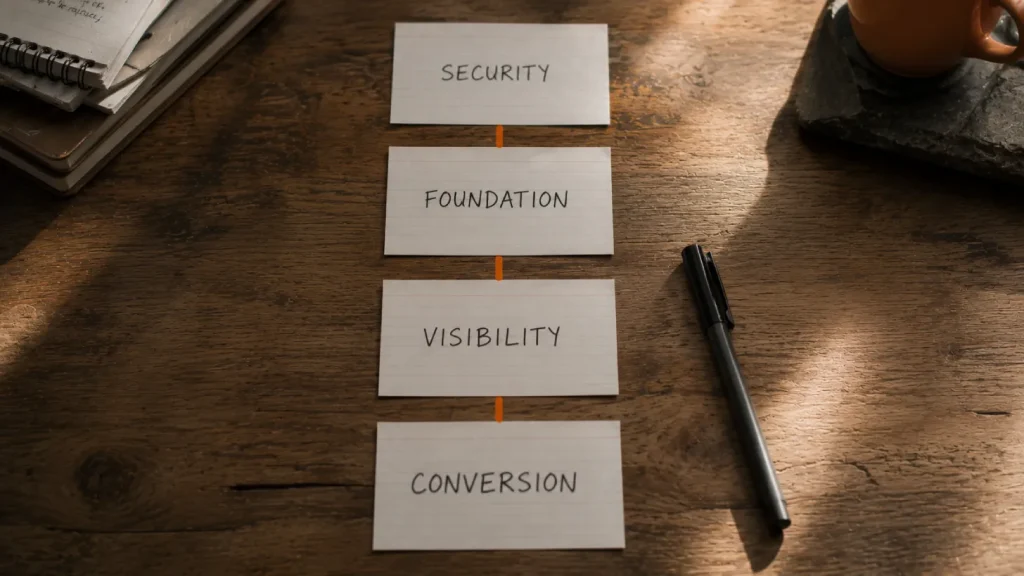
Security
Malware, unauthorized admins, injected pages, SEO spam, backdoors left from an old compromise. Most people never check because there’s nothing to see. That’s the entire point of a good compromise. And then hardening it so it doesn’t happen twice.
Foundation
Can the site do its job?
Speed, mobile, crawlability, indexation, canonical tags, broken redirects, plugin conflicts, hosting. Boring. Where the man with the handshake photo actually lived, and it’s the boring foundation work that keeps it fixed.
Visibility
Can you be found, by Google and by the answer engines?
Rankings, local presence, schema, entity consistency, and whether ChatGPT and Perplexity name you when asked what you do. Most audits skip this half entirely, because most auditors haven’t updated their checklist since 2023.
Conversion
When someone does arrive, what happens?
Message clarity, proof, friction, forms that silently fail, calls that go nowhere.
How it works
What actually happens. In this order.
Access and a short call from you. Everything else is on me. Timing depends on what I find: a hacked site gets contained first, and clean-up typically takes a few days to a week depending on how deep it goes.
- Step 1
Access and intake.
Access to your site, hosting and analytics. A 30-minute call. Not a sales call: I’m asking when it broke, what changed, and what you’ve already tried. Then a full backup, before I change anything.
- Step 2
Contain.
If someone else is in your site: credentials rotated, attacker locked out, a forensic snapshot taken. Stop it getting worse first.
- Step 3
Find the cause.
Full malware and integrity scan. Every admin account. File change history. Injected content. Then crawl, index, speed and structure. The entry point, not just the symptom.
- Step 4
Clean up and close the door.
Remove what was put there and close the way in. Fix what’s causing the damage within the Site Rescue’s scope. Every change logged.
- Step 5
Findings call.
I walk you through what was found, what was fixed, and what’s left, in order. You ask hard questions. You leave with the report.
What you get
Your site back, and the report.
- Containment and clean-up of what’s causing damage, with the entry point closed
- A full backup taken before any change
- A written report: what was found, what was fixed, every change made
- A ranked list of what’s left, by cost and effort, if anything is
- A straight answer on which items you can do yourself. Some of them, you can.
What this is not
It isn’t a ranking or AI visibility project. The priority is getting your site back online, the way it was before the problem. Ranking, rebuilds and AI visibility come after, and they’re quoted separately. See all services →

Want to see what a rescue looks like in practice?
Why it costs $997
Because free audits aren’t audits.
A free audit is a lead magnet. It’s built to produce a scary PDF that ends in a proposal for the service the agency already wanted to sell. You’ve probably had one: 47 pages, half of it automated tool output, red warning triangles about things that don’t matter, and a conclusion that surprises nobody.
| Free audit | The Site Rescue | |
|---|---|---|
| What it is | A lead magnet | Paid work with no predetermined answer |
| Conclusions | Pre-loaded, pointed at the service the agency sells | Including “you don’t need me” and “this bit’s fine, leave it alone” |
| The output | 47 pages, half of it tool output | The damage cleaned up, and a written report of what was found, fixed and left |
| Who it’s for | The agency’s proposal | You, or any competent developer you hand it to |
The SOS Site Rescue
Find it. Fix it. Get back online.
- Four systems: Security, Foundation, Visibility, Conversion
- Containment and clean-up, written report, ranked next steps
- Full backup before any change, every change logged
Will $997 be enough?
In most cases, yes: small and medium sites are usually fully recovered within the $997 Site Rescue. Larger sites can need more work. If yours does, you’ll know the scope and the cost before anything beyond $997 is done. Quoted up front, no hourly billing.
What if my site isn’t hacked?
Then it’s the same $997. I find the real problem, fix the quick wins that fit within the Site Rescue, and give you a ranked list of what’s left. Paying for it means I owe you the truth, including “you don’t need me” and “this bit’s fine, leave it alone.”
Booking
How to start. Three steps, no sales sequence.
Pay the $997 through PayPal.
Pay through PayPal. I’ll email you within one business day, usually much sooner, to get access and book the 30-minute intake call. Questions first? Use the form on the contact page, or call (754) 302-4631 during working hours (text it outside them). Your domain and what’s going on is plenty.
Get a reply the same day.
On weekdays, usually within a few hours. One person answers, and the same person does the work.
Work starts.
Access, the 30-minute intake call, and a full backup. Then containment first, if it’s needed.
Frequently asked questions
Straight answers.
How much does the SOS Site Rescue cost?
$997, fixed, quoted up front, no hourly billing. For most small and medium sites that covers finding the problem and cleaning it up. If yours needs more, you’ll see the scope and the cost before anything beyond $997 is done.
How is this different from a free website audit?
A free audit is a sales document with pre-loaded conclusions, usually generated by a tool and pointed at the service the agency sells. The Site Rescue is paid work with no predetermined answer — including the answer that your site is fine and your problem is elsewhere. You get a written account of what was found and what was fixed.
What if you find my site has been hacked?
Then the clean-up is part of the Site Rescue. Containment comes first, then I find the entry point and remove what was put there. Small and medium sites are usually recovered within the $997; if yours needs more, you’ll know the cost before I go further. Most people ask me, because I’ve been on the receiving end of exactly that discovery.
Do I have to hire you afterwards?
No. The Site Rescue stands on its own: find it, fix it, write it up. Anything further, such as ranking work or a rebuild, is a separate decision, and the report is written so you can hand it to any competent developer or agency.
How long does it take and what do you need from me?
It depends on what I find. A hacked site gets contained first; clean-up typically takes a few days to a week depending on how deep the infection goes. I need access to your website and hosting, plus a 30-minute intake call and a findings call at the end. I take a full backup before I change anything. Everything else is on me.
Will this get me ranking in Google and AI answers?
No. Not at first. The priority is getting your site back online, the way it was before the problem. Ranking, rebuilds and AI visibility come after, and they’re quoted separately. See all services →
After the Site Rescue
Where the next work goes: Rescue, Rebuild, Rank, Run. The order is the method.
Stop guessing
He didn’t need a new website. He needed somebody to look before selling.
The man with the handshake photo still has that homepage. He never did rebuild it. His phone rings now, because the actual problem was a broken tag that took a morning to fix, and once he could be found again the homepage turned out to be perfectly adequate.
Find it. Fix it. Get back online. $997.
Site actively down or compromised? Call (754) 302-4631 first.